The European Space Agency's Euclid telescope was sent to space to solve one of the biggest puzzles in physics: what dark matter and dark energy really are. It was never meant to be a comet hunter. But in images taken in September 2026, it caught a faint, fast-moving smudge that turned out to be a comet nobody had ever seen. It now carries the telescope's name: C/2026 S1 (Euclid).
Key takeaways
- Comet C/2026 S1 (Euclid) is the first new comet discovered by ESA's Euclid space telescope.
- It was spotted in images taken between 16 and 24 September 2026 and announced by ESA in the autumn.
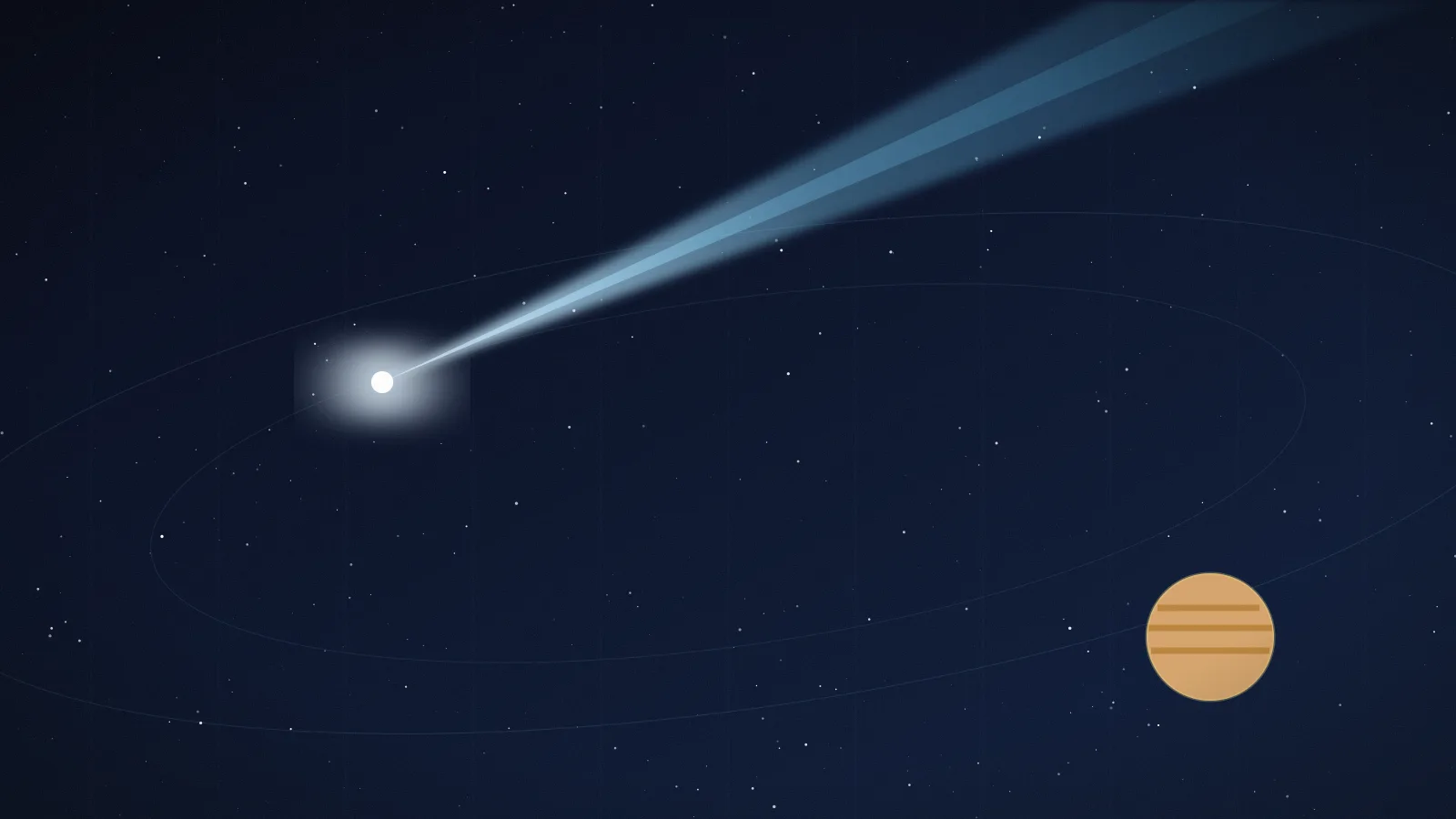
- The comet is about 1.3 billion km away, roughly between the orbits of Jupiter and Saturn, on an orbit lasting thousands of years.
- It was found by University of Helsinki PhD student Mikko Pöntinen using motion-detection software he wrote.
A telescope built for the dark universe
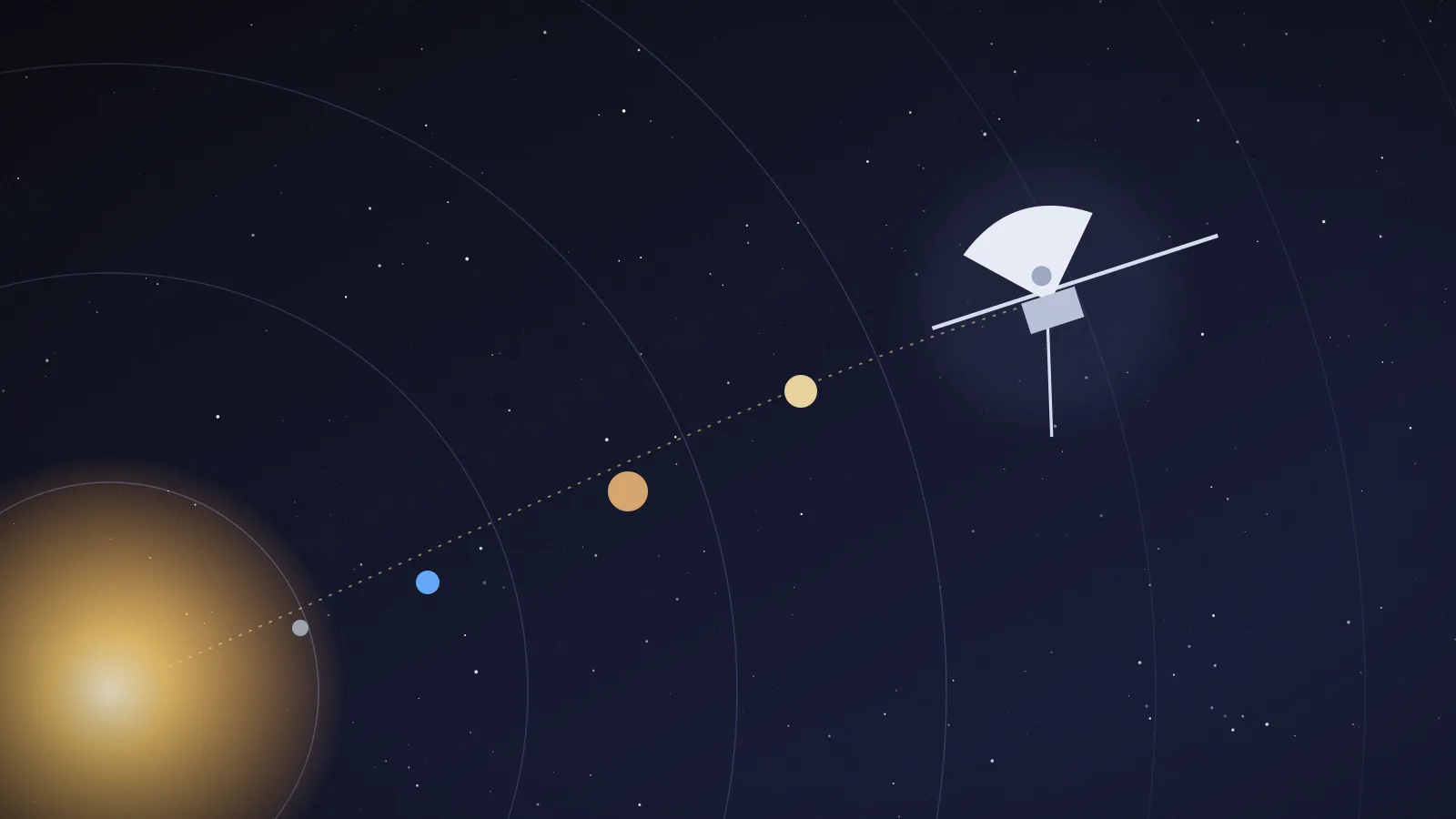
Euclid launched on 1 July 2023 and now works from a stable point in space about 1.5 million kilometres from Earth, on the side facing away from the Sun. Its job is to photograph billions of galaxies across about a third of the sky. By measuring how the light of distant galaxies is subtly bent and how galaxies are spread across space, scientists hope to map invisible dark matter and learn how dark energy is speeding up the expansion of the universe.
To do that, Euclid takes several exposures of each patch of sky, a few minutes apart. Distant galaxies stay put between exposures. Anything inside our own Solar System, however, moves. For most of the mission's scientists those moving objects are a nuisance. For a few, they are a treasure.
How the comet was found
Mikko Pöntinen, a doctoral researcher at the University of Helsinki, developed software that searches Euclid's images for objects that shift position from one frame to the next. In the September images, it flagged a streak smeared across several exposures, a sign of something moving quickly against the background stars.
The team checked the object against catalogues of every known comet and asteroid. There was no match. The observations were sent to the Minor Planet Center, the international clearing house for Solar System discoveries, and the object was confirmed as a new comet. ESA has said that the process also gave its teams a real test of how they would coordinate if Euclid found something urgent in the future.
Where is C/2026 S1 now?
The comet is about 1.3 billion kilometres from Earth, a distance that places it between the orbits of Jupiter and Saturn. Its orbit is steeply tilted, carrying it well above the flat plane in which the planets travel, and it takes thousands of years to go once around the Sun.
Comets on orbits like this are thought to come from the Oort cloud, a vast, spherical reservoir of icy bodies at the outer edge of the Solar System. A passing star or the gentle tug of the Milky Way can nudge one of these objects inward. Studying them gives astronomers a sample of material that has barely changed since the planets formed about 4.6 billion years ago.
Can you see it?
No. C/2026 S1 is far too faint for the naked eye or for ordinary backyard telescopes. It was found by one of the most sensitive cameras ever flown, and observing it will require large professional telescopes. It is not expected to become a bright comet in our skies.
Why a dark-matter telescope finding comets matters
Euclid had already recorded known comets and asteroids in its images. What is new is that it has now discovered one. That matters because Euclid's survey will cover an enormous area of sky over several years, at depths that ground-based telescopes struggle to match. Scientists expect it to pick up many small Solar System bodies as a side effect of its main mission.
Each discovery helps fill in the census of objects in our cosmic neighbourhood, from asteroids that could one day approach Earth to icy wanderers like C/2026 S1. And it is a good example of a pattern that runs through the history of astronomy: build a powerful instrument for one purpose, and it will surprise you with another.
Distant galaxies stay put between exposures. Anything inside our own Solar System moves, and that movement is how C/2026 S1 gave itself away.
The bigger picture
Euclid is joining a busy era for sky surveys. Ground-based observatories such as the Vera C. Rubin Observatory in Chile are designed specifically to catch moving and changing objects, and they are expected to find millions of asteroids and many thousands of comets. Euclid's view from space, free of the blurring of the atmosphere, complements those surveys. Together they are giving astronomers the most complete picture yet of the small bodies that circle the Sun.
Sources
- European Space Agency, Euclid discovers new comet
- BBC Sky at Night Magazine, Comet C/2026 S1 (Euclid)
- Space.com, Euclid space telescope discovers its 1st comet
- Sci.News, ESA's Euclid Space Telescope Discovers Its First Comet
- European Space Agency, Euclid mission overview