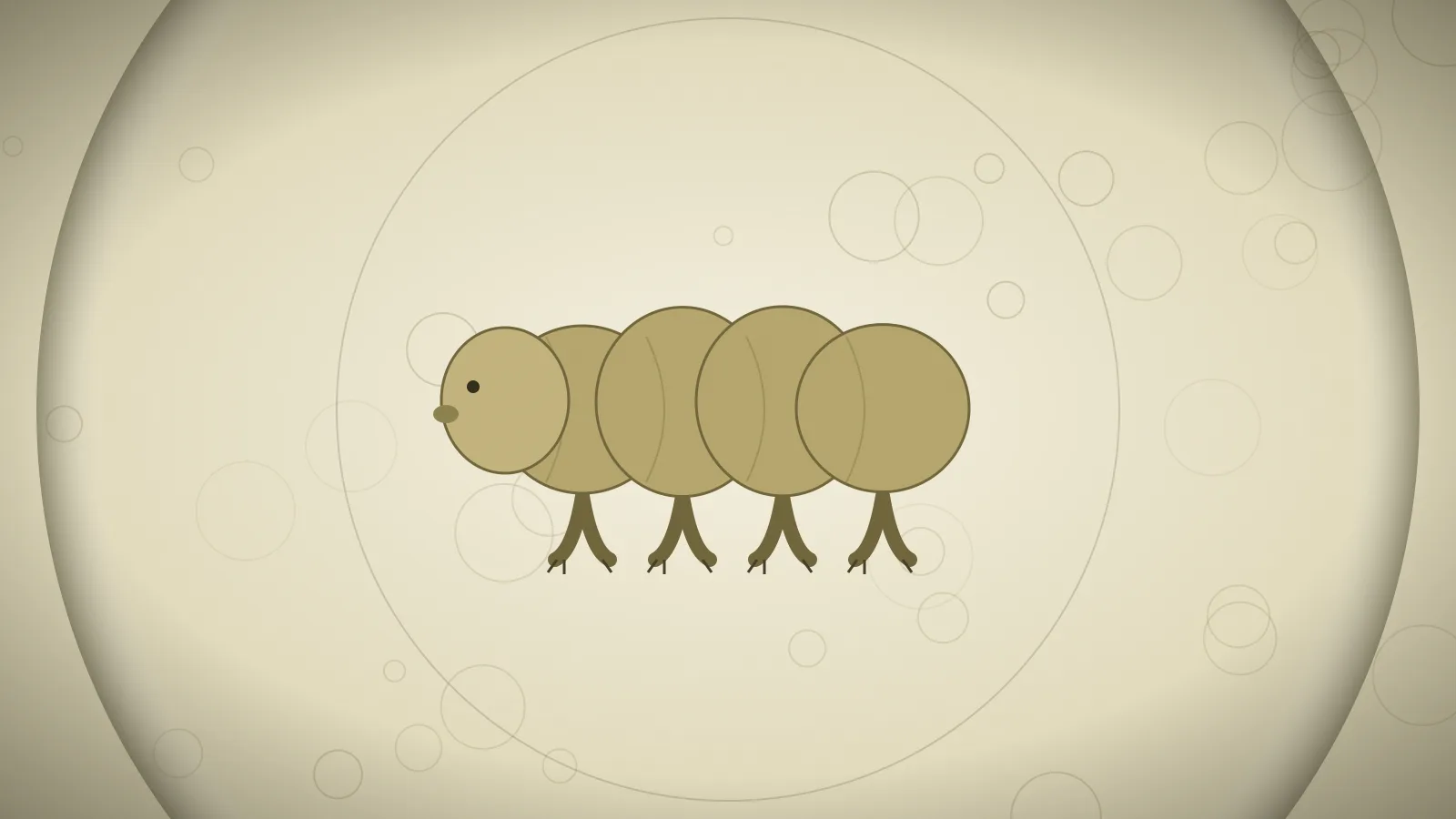
They are smaller than a grain of sand, they look like chubby eight-legged gummy bears, and they live almost everywhere: in moss on your garden wall, in Antarctic lakes, in deep-sea mud and on mountain tops. Tardigrades, also called water bears, have become internet celebrities because of their legendary toughness. They can survive being dried out for years, frozen close to absolute zero, blasted with radiation and even exposed to the vacuum of space. Here is how they do it, and which of the famous claims are true.
Key takeaways
- There are more than 1,300 known species of tardigrade, most under a millimetre long.
- When their environment dries out, many species enter a dormant "tun" state and can revive years later when wet.
- Tardigrades have survived direct exposure to space in low Earth orbit.
- They survive extremes but do not thrive in them; in their active state they are much more fragile.
Meet the water bear
Tardigrades were first described in 1773 by the German pastor Johann August Ephraim Goeze, who called them "little water bears" because of their lumbering, bear-like walk. A few years later, the Italian scientist Lazzaro Spallanzani named the group Tardigrada, meaning "slow steppers".
Most species are between 0.1 and 0.5 millimetres long, although the largest reach about 1.5 millimetres. They have four pairs of stubby legs tipped with claws, a tube-like mouth with sharp stylets for piercing plant cells or small animals, and a simple brain. They need a film of water around them to be active, which is why moss and lichen, which hold moisture, are favourite homes.
The tun: life on pause
The secret to the tardigrade's toughness is a state called cryptobiosis, which means "hidden life". When its surroundings dry out, a tardigrade pulls in its legs and head, loses almost all of the water in its body and curls into a compact, barrel-shaped form called a tun. Its metabolism drops to almost undetectable levels.
In this state, the animal is not dead, but it is not really living either. When water returns, it can rehydrate and start walking again, sometimes within minutes or hours. Some tardigrades have been revived after more than a decade in a dried state, and in 2016 Japanese researchers revived tardigrades that had been frozen in a moss sample for over 30 years.
What can tardigrades really survive?
Space
In 2007, the European TARDIS experiment sent dried tardigrades into low Earth orbit aboard a Russian FOTON-M3 satellite. Exposed to the vacuum of space for about ten days, many survived and went on to reproduce after returning to Earth. A smaller number even survived exposure to harsh solar ultraviolet radiation, making tardigrades the first animals known to survive the combined vacuum and radiation of space.
Radiation
In their tun state, some tardigrades can withstand doses of radiation hundreds of times greater than would kill a human. Part of their protection comes from a protein discovered in 2016 in the species Ramazzottius varieornatus, named Dsup, short for "damage suppressor". It binds to DNA and shields it. When scientists added Dsup to human cells in the laboratory, the cells suffered about 40% less damage from X-rays.
Extreme cold and heat
Dried tardigrades have survived brief exposure to temperatures within a degree of absolute zero in laboratory experiments, and some have survived short spells at temperatures above the boiling point of water. Heat is their weak spot, though: active tardigrades are killed by long exposure to temperatures that are merely hot, not extreme.
Crushing pressure
Experiments have shown tardigrades can survive pressures several times greater than those at the bottom of the deepest ocean trench.
Tardigrades are not superheroes. They are masters of waiting, able to switch life off until conditions improve.
Are there tardigrades on the Moon?
Possibly, but probably dead ones. In 2019, the Israeli spacecraft Beresheet crash-landed on the Moon carrying a small archive that included thousands of dried tardigrades. A 2021 study in the journal Astrobiology fired tardigrades from a gun at high speed to test whether they could survive such an impact. They survived impacts up to about 900 metres per second but not faster ones, and Beresheet probably hit the surface harder than that. Even if some survived, they would have no liquid water to revive in.
Why scientists care
Tardigrade biology could have practical uses. Researchers are exploring whether tardigrade proteins could help protect vaccines and medicines without refrigeration, shield crops from drought or radiation, or protect astronauts and cells from radiation on long space missions. They also help scientists think about where life could survive elsewhere in the Solar System.
How to find your own tardigrade
You do not need a lab. Collect a small clump of dry moss or lichen from a wall or tree, soak it in rainwater or bottled water in a shallow dish for a few hours, then squeeze the water out and look at it under a simple microscope or a strong magnifier at about 40x. With a little patience, you may spot a water bear lumbering through the debris.
Sources
- Jönsson et al., Current Biology (2008), Tardigrades survive exposure to space in low Earth orbit
- Hashimoto et al., Nature Communications (2016), Extremotolerant tardigrade genome and improved radiotolerance of human cultured cells by tardigrade-unique protein
- Boothby et al., Molecular Cell (2017), Tardigrades use intrinsically disordered proteins to survive desiccation
- Traspas & Burchell, Astrobiology (2021), Tardigrade survival limits in high-speed impacts
- Wikipedia, Tardigrade