It sounds like a headline designed to start arguments: "Climate change stopped the next ice age." That is, in fact, the title of a research paper published in the journal Science on 22 October 2026. Its authors argue that a small ice cap in Arctic Canada began a slow, steady advance about 2,000 years ago, possibly the first stirrings of a new glacial period, before rising temperatures reversed it in the 1960s. The idea is fascinating. It is also more complicated, and less comforting, than it first appears.
Key takeaways
- The study focuses on an ice cap on Baffin Island that grew slowly for about 2,000 years and then started shrinking in the 1960s.
- The authors argue that this growth marked the start of Earth's next glaciation, which modern warming then halted.
- Other climate scientists caution that most models say the next ice age was not due for tens of thousands of years anyway.
- Even the lead author warns against reading this as "warming saved us from an ice age".
Why ice ages come and go
For the past few million years, Earth has swung between long, cold glacial periods, when ice sheets covered much of North America and Europe, and shorter warm interglacials like the one we live in today. Our current interglacial, the Holocene, began about 11,700 years ago.
The rhythm is set largely by slow changes in Earth's orbit and tilt, known as Milankovitch cycles. Over tens of thousands of years, the shape of Earth's orbit, the angle of its axis and the timing of the seasons all shift. When summers in the far north become cool enough that winter snow fails to melt, snow builds up year after year, compresses into ice and spreads into ice sheets. Feedbacks such as falling carbon dioxide and more reflective white ice then deepen the cold.
What the Baffin Island ice cap reveals
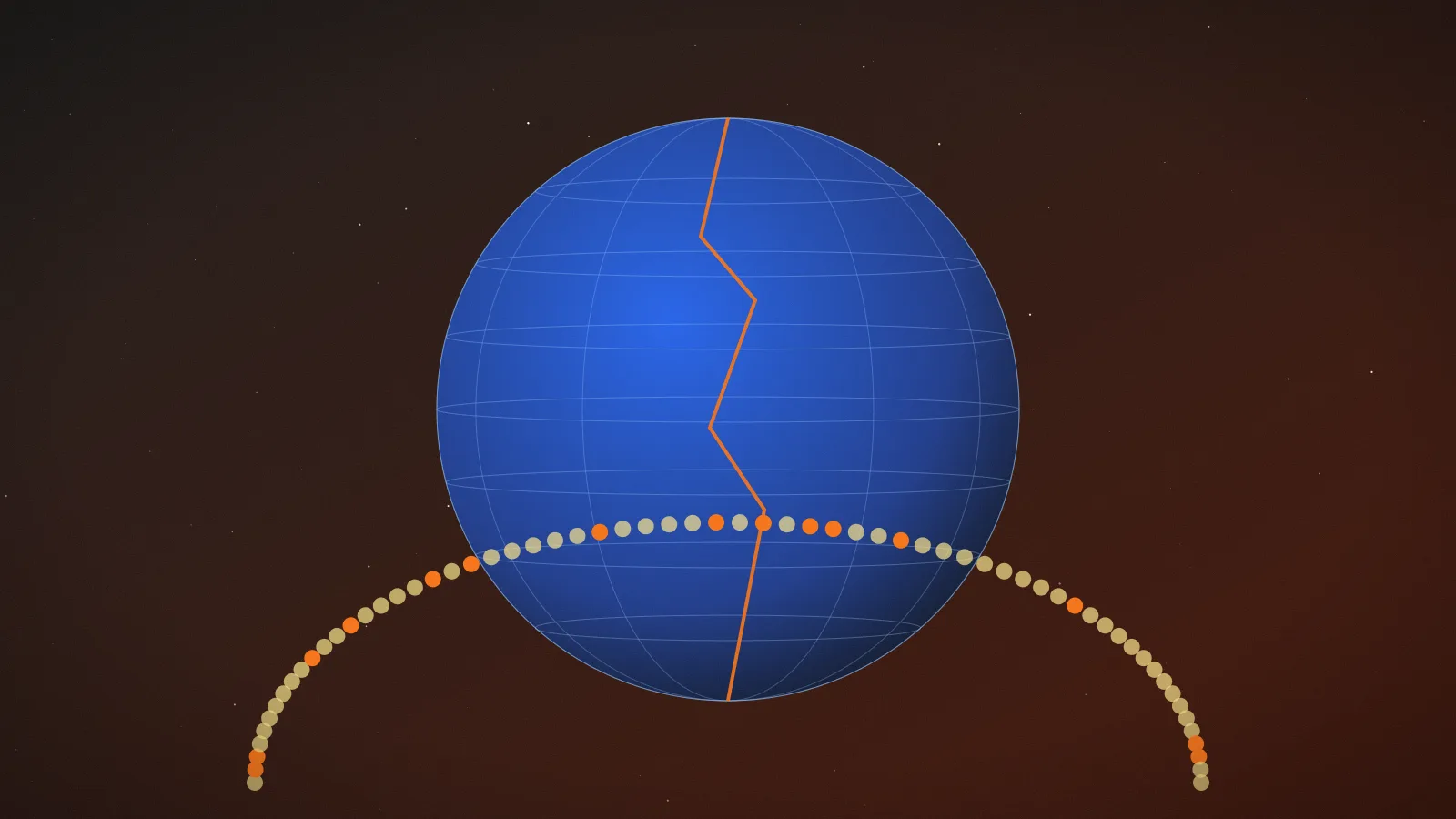
The new study looks at a shrinking ice cap on Baffin Island in the Canadian Arctic, a region where the ice sheets of past glacial periods first took hold. According to the researchers, the ice cap started to slowly and steadily re-expand around 2,000 years ago, as northern summers gradually cooled in line with orbital trends.
The team argues that this regrowth was not just a local quirk but the beginning of Earth's next glacial period. The growth reversed in the 1960s, which they link to rising summer temperatures driven by human greenhouse gas emissions.
The scientific pushback
Not everyone is convinced. One climate modeller quoted in coverage of the study pointed out that other modelling studies, including his own, conclude that the next ice age would not be expected for another 50,000 years or so, even without global warming.
That view is backed by earlier work. A widely cited 2016 study in Nature by researchers at the Potsdam Institute for Climate Impact Research found that the current orbital setup only weakly favours a new glaciation, and that human carbon dioxide emissions are likely to postpone the next ice age by at least 50,000 years. A 2025 study estimated that, without human influence, the next glaciation might have started within roughly the next 11,000 years.
There is also the question of evidence. The 2026 study's central claim rests on one ice cap's record. A single ice cap can respond to local factors, such as snowfall and wind patterns, as well as to global climate. More records from across the Arctic would be needed to show that the whole planet was heading into a glacial period.
Even if humans postponed an ice age, the speed of today's warming brings its own dangers, ones our societies are far less prepared for.
So is warming a good thing after all?
No, and the lead author of the study is clear about that. Ice ages develop over many thousands of years, giving ecosystems time to move and adapt. Today's warming is happening over decades. It is already intensifying heatwaves, raising sea levels, shifting rainfall and stressing crops and coral reefs. A distant ice age, if it ever came, would have unfolded far more slowly than the changes we are causing now.
The comparison also cuts the other way. If the climate system is sensitive enough that a few centuries of human emissions can halt or delay a process driven by Earth's orbit, it shows just how powerful our influence on the planet has become.
What this changes, and what it doesn't
The study is a provocative contribution to an old debate about how close Earth was to its next glaciation. Whether or not its interpretation holds up, the bigger picture remains the same: human greenhouse gas emissions now dominate the direction of Earth's climate, and they will continue to do so for a very long time. An ice age is not the threat we face. Rapid warming is.
Sources
- CNN via KRDO, Humans accidentally canceled the next ice age, but it's no reason to celebrate, scientists say
- The Debrief, Scientists once warned of a coming ice age. New research reveals what may have stopped it
- Euronews, Human-caused emissions have delayed Earth's next ice age, study says
- Ganopolski, Winkelmann & Schellnhuber, Nature (2016), Critical insolation–CO2 relation for diagnosing past and future glacial inception
- World Economic Forum, Have humans postponed the next ice age?