Scientists Discovered That Trees Talk To Each Other
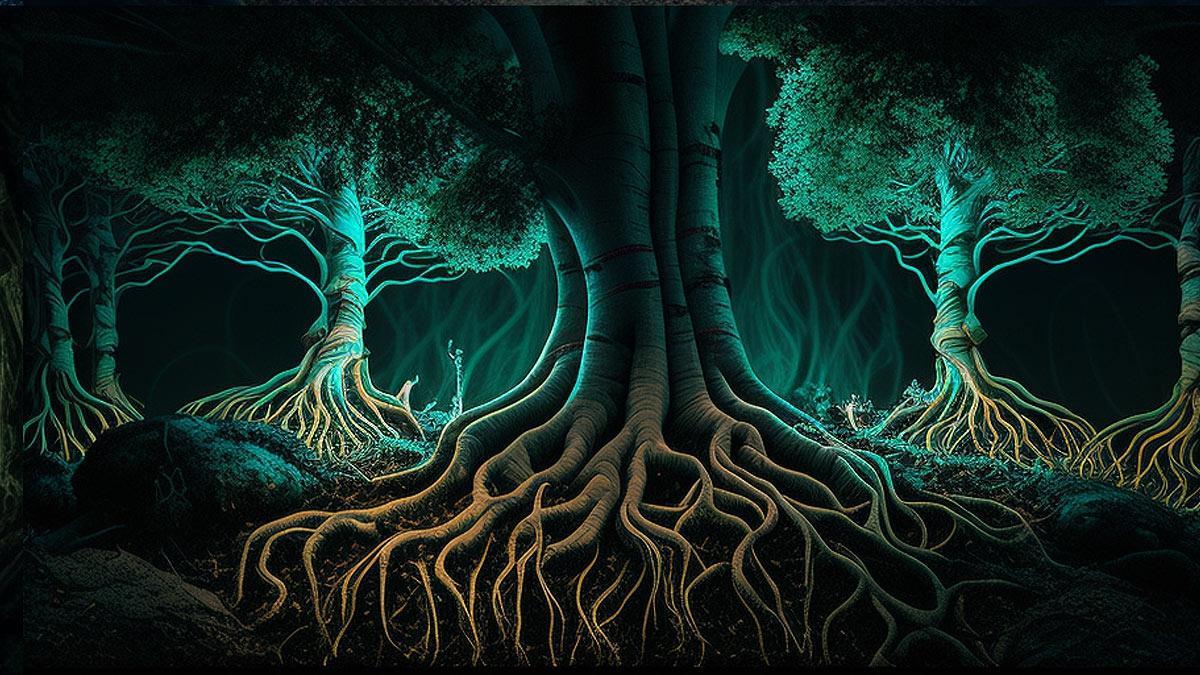
Beneath the forest floor lies a hidden world that has revolutionized our understanding of nature. Trees, long viewed as solitary individuals competing for resources, are actually members of sophisticated social networks—communicating, sharing resources, and even caring for their young through an underground internet of fungal threads scientists call the "Wood Wide Web."
The Underground Network: Nature's Original Internet
For millions of years, forests have been connected by vast underground networks of mycorrhizal fungi—thread-like organisms that colonize tree roots and extend into the surrounding soil. A single handful of forest soil can contain miles of these fungal threads, called hyphae, creating a biological network that connects nearly every tree in a forest.
This symbiotic relationship benefits both parties. Trees provide the fungi with sugars produced through photosynthesis—up to 30% of the carbon a tree fixes from the atmosphere. In return, the fungi dramatically expand the tree's root system, increasing water and nutrient absorption by up to 1,000 times. But the exchange goes far beyond this simple trade.
Chemical Conversations Through the Canopy
Trees don't just communicate underground—they also send messages through the air. When a tree is attacked by insects, it releases volatile organic compounds (VOCs) into the atmosphere. These chemical signals serve multiple purposes.
First, they act as a distress signal to neighboring trees. Upon receiving these airborne warnings, nearby trees begin producing defensive chemicals—bitter-tasting compounds and toxins that make their leaves unpalatable to insects—even before being attacked themselves. This preemptive defense can reduce herbivore damage by up to 40%.
Second, these chemical signals can summon help. Certain VOCs attract predatory insects and parasitic wasps that feed on the herbivores attacking the tree. Essentially, the tree is calling in reinforcements—recruiting an aerial defense force through chemical messaging.
The Discovery That Changed Everything
The groundbreaking research revealing tree communication networks began in the 1990s with forest ecologist Suzanne Simard. Working in the Douglas fir forests of British Columbia, she designed an elegant experiment that would fundamentally change how we understand forests.
Simard covered Douglas fir and birch trees with plastic bags and injected them with different isotopes of carbon—radioactive markers she could trace through the forest. The Douglas fir received carbon-13, while the birch received carbon-14. What happened next astonished the scientific community.
The radioactive carbon didn't stay in the injected trees. Within hours, both isotopes appeared in both species—the carbon was moving between trees, flowing through the fungal network connecting their roots. Trees were sharing resources through an underground pipeline.
Even more remarkably, the direction and amount of sharing changed with the seasons. In summer, when birch trees were fully leafed and photosynthesizing vigorously while Douglas firs were shaded, carbon flowed from birch to fir. In fall, when birch lost their leaves but firs remained green, the flow reversed. The trees were engaged in a reciprocal exchange, sharing resources based on need.
Mother Trees: The Hub of Forest Networks
Further research revealed that not all trees in a forest are equal participants in these networks. Ancient, large trees—termed "Mother Trees" or "Hub Trees"— serve as central nodes in the mycorrhizal network, connected to hundreds of younger trees.
The Role of Mother Trees
Mother Trees perform several crucial functions in forest ecosystems:
- Resource distribution: They channel nutrients and water to younger trees, particularly their own offspring, increasing survival rates of seedlings by up to 400%
- Network architecture: Their extensive root systems create the structural backbone of the mycorrhizal network
- Information hubs: They transmit warning signals about environmental stresses, disease, and insect attacks throughout the network
- Legacy support: Dying Mother Trees dump their remaining resources into the network, providing a final gift to the next generation
Studies in old-growth forests show that removing Mother Trees doesn't just eliminate one tree—it can cause a cascade of deaths among younger trees that depended on them, reducing overall forest resilience by up to 26%.
Kin Recognition: Trees Know Their Family
Perhaps most surprisingly, research suggests trees can recognize their own offspring and even siblings. In controlled experiments, Douglas fir Mother Trees allocated more carbon to their own kin than to strangers.
When grown with siblings versus non-related individuals, some tree species adjust their growth strategies. Trees grown with siblings develop fewer competitive roots and invest more in aboveground growth—essentially cooperating rather than competing for soil resources. With strangers, they develop aggressive root systems and compete more intensely.
The mechanism for this recognition remains under investigation, but scientists believe it may involve chemical signatures in root exudates—compounds that roots secrete into the soil. These chemical fingerprints may allow trees to distinguish family from strangers.
Warning Networks: Forests Under Attack
The fungal network serves as an early warning system. When a tree is attacked by pests or pathogens, it sends defense signals through the mycorrhizal network. Connected trees receive these warnings and begin producing defensive compounds before being attacked themselves.
In a striking example, acacia trees in the African savanna demonstrate both airborne and underground communication. When giraffes begin browsing on acacia leaves, the trees rapidly increase the tannin content in their leaves—making them bitter and toxic. Within 15-30 minutes, nearby acacias that haven't been touched also increase their tannin levels, having received either airborne chemical signals or underground fungal messages.
Giraffes have evolved to counter this defense by moving to trees downwind and at least 100 meters away—beyond the range of the warning signals.
Nurse Logs and Forest Regeneration
Even in death, trees continue supporting the network. Fallen logs, called nurse logs, become colonized by mycorrhizal fungi and serve as nutrient reserves and fungal highways. Seedlings growing on nurse logs tap into established networks immediately, gaining access to resources and information from their first days of life.
In old-growth forests, up to 95% of young trees establish on nurse logs rather than mineral soil. These seedlings show dramatically higher survival rates—often three to five times greater than those growing in soil—because they're instantly connected to the wood wide web.
The Carbon Sharing Economy
The resource exchange between trees is more complex than simple charity. Research has revealed sophisticated trading dynamics within the network:
- Trees receive more resources when they need them most—during stress, drought, or shade
- The fungal partners appear to act as mediators, potentially taking a "commission" for facilitating transfers
- Trees that contribute more to the network tend to receive more in times of need—a form of biological investment banking
- Different fungal species create different network properties, with some facilitating more generous sharing than others
Scientists estimate that in a mature forest, up to 40% of the carbon in a tree's roots may have originally been fixed by another tree's leaves—transferred through the network. This represents a massive redistribution of resources that challenges our understanding of forests as collections of competing individuals.
Stress Signals and Environmental Response
The mycorrhizal network doesn't just transfer nutrients—it transmits information about environmental conditions. When one part of a forest experiences drought, stress signals propagate through the network, allowing distant trees to prepare by adjusting their water use and growth patterns.
In controlled experiments, trees connected by fungal networks showed synchronized stress responses even when only some were experiencing adverse conditions. Trees receiving stress signals through the network reduced their stomatal opening (conserving water) and altered their hormonal profiles to match drought conditions— despite having adequate water themselves.
Different Species, Different Strategies
Not all trees participate equally in sharing networks. Research has identified different networking strategies among species:
The Generous Sharers
Some species, like birch and Douglas fir, form extensive sharing networks and readily exchange resources with both related and unrelated individuals. These species tend to dominate stable, old-growth forests.
The Conservative Traders
Other species, like some pines, form more limited networks and share resources more selectively. These trees often excel in disturbed or newly established forests where individual competition provides advantages.
The Network Specialists
Certain understory species have evolved to specialize in tapping into the mycorrhizal networks of larger trees, essentially piggybacking on established connections without contributing proportionally to the network.
Implications for Forest Management
Understanding tree communication networks has profound implications for how we manage and conserve forests:
Selective Logging Reconsidered
Traditional forestry often removes the largest, oldest trees—precisely those serving as Mother Trees. This practice doesn't just remove timber; it destroys the network architecture that supports hundreds of younger trees. Modern sustainable forestry increasingly preserves these hub trees to maintain network integrity.
Reforestation Strategies
Planting monoculture tree plantations creates forests that lack the diversity of mycorrhizal partnerships found in natural forests. These simplified systems are more vulnerable to disease and stress because they lack the information- sharing and resource-buffering of complex networks.
Progressive reforestation efforts now focus on:
- Preserving existing Mother Trees in planting areas
- Maintaining fungal network integrity in the soil
- Planting diverse species that form complementary network partnerships
- Protecting nurse logs that serve as network hubs for seedlings
Climate Change Resilience
As climate patterns shift, the ability of forests to share resources and information may prove crucial for survival. Networks allow forests to:
- Buffer individual trees against environmental extremes through resource sharing
- Rapidly propagate adaptive information about new stresses
- Support vulnerable individuals during transitional periods
- Maintain genetic diversity by supporting less competitive but potentially better-adapted individuals
The Frontiers of Forest Communication Research
Scientists continue to uncover new dimensions of tree communication. Recent discoveries include:
Electrical Signaling
Trees generate electrical signals in response to stimuli, similar to neural impulses in animals. These signals can propagate through tissues at speeds up to one centimeter per second—slow compared to animal nervous systems but potentially significant for coordinating responses across large organisms.
Sound Production
Some researchers have detected ultrasonic emissions from trees, particularly during drought stress. While controversial, this finding suggests trees might produce acoustic signals—potentially the sound of air bubbles forming in water-conducting vessels, which could serve as stress indicators.
Memory and Learning
Evidence suggests trees may possess forms of memory. Trees that have previously experienced drought show faster and stronger responses to subsequent water stress—as if they "remember" the experience and prepare more efficiently.
Rethinking What Forests Are
The discovery of tree communication networks forces us to reconceptualize what forests are. Rather than mere collections of individual trees competing for resources, forests emerge as superorganisms—integrated communities where cooperation and communication are as important as competition.
This perspective has philosophical implications beyond forestry. It challenges the paradigm of nature as purely "red in tooth and claw," revealing instead sophisticated cooperation and mutual aid as fundamental survival strategies. The wood wide web demonstrates that even organisms without brains or nervous systems can form intelligence networks—collective systems greater than the sum of their parts.
As climate change and habitat loss accelerate, understanding and protecting these communication networks may prove essential not just for forests, but for maintaining the complex ecological relationships that sustain life on Earth. The trees have been talking all along—we're only now learning to listen.
Every walk in the forest becomes different when you know that beneath your feet, an ancient conversation is taking place—a living network sharing resources, transmitting warnings, and nurturing the next generation. The forest, it turns out, is less like a battlefield and more like a community— one that has been thriving on cooperation for millions of years before humans arrived to witness it.